
Sleep Is Foundational
— We Support It With Science
Sleep is essential to how the body and mind function. It plays a critical role in cognitive performance, memory consolidation, physical recovery, hormonal regulation, immune health, and emotional resilience. When sleep quality declines, so does decision-making, reaction time, mood stability, and long-term health.
Modern, high-performance lifestyles place increasing demands on the nervous system — making consistent, restorative sleep more important than ever. Understanding how sleep works is the first step toward supporting it.
What Happens During Sleep
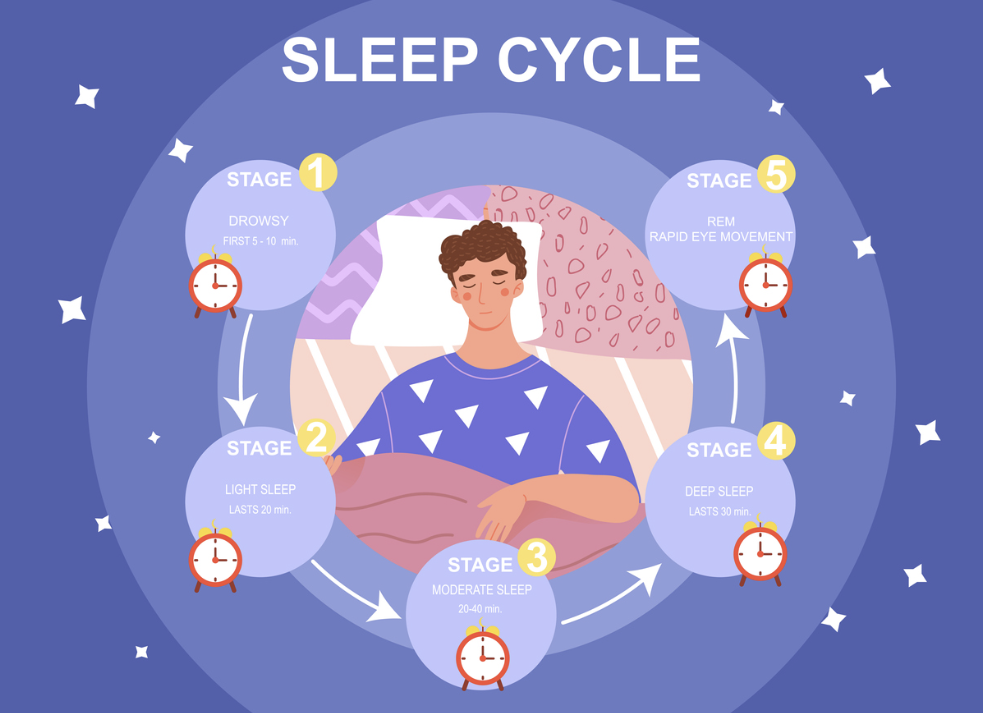
Sleep occurs in five distinct stages, each playing a critical role in recovery, brain function, and overall health. A full sleep cycle typically lasts 90–110 minutes and repeats multiple times throughout the night.
As the night progresses, early cycles contain more deep sleep, while later cycles shift toward lighter sleep and longer REM periods.
-
Stage 1 is the lightest phase of sleep and marks the transition between being awake and falling asleep. During this stage, the body and brain begin to slow down, but sleep is still easily disrupted.
You may drift in and out of sleep
Eye movements slow
Muscle activity begins to decrease
Sudden muscle contractions may occur, sometimes accompanied by a falling sensation (hypnic myoclonia)
If awakened, you may recall fragmented images or sensations
Brain activity: Alpha and theta waves
Typical duration: ~7 minutes -
Stage 2 accounts for nearly half of total sleep time and represents a more stable form of light sleep. The body becomes less responsive to outside stimuli, allowing sleep to deepen.
Eye movements stop
Heart rate and breathing continue to slow
Body temperature drops
The brain produces sleep spindles — brief bursts of rapid brain activity that help protect sleep
Brain activity: Slower waves with sleep spindles
Typical duration: 10–15 minutes per cycle -
Physical restoration and recovery (in the dropdown box) Stage 3 marks the beginning of deep sleep and is one of the most restorative phases of the night. Awareness of the external environment fades significantly.
Brain waves slow considerably
Muscles are relaxed and inactive
Eye movement stops
It becomes difficult to wake up
If awakened, disorientation or grogginess may occur
This stage is considered critical for physical recovery, immune support, and tissue repair.
Brain activity: Delta waves with occasional faster waves
Known for: Sleepwalking, bedwetting, and night terrors (especially in children) -
Maximum physical restoration (in the dropdown box) Stage 4 is the deepest stage of sleep and represents the most profound level of physical restoration.
Faster brain waves disappear almost entirely
Delta waves dominate brain activity
There is no eye movement
Muscles remain still
Waking from this stage is particularly difficult
If awakened directly from Stage 4, people often feel sluggish, disoriented, and groggy for several minutes.
Brain activity: Almost exclusively delta waves
-
Brain recovery, learning, and dreaming (in the dropdown box) REM sleep is the final stage of the sleep cycle and plays a key role in cognitive function and emotional processing. Approximately 20% of total sleep time is spent in REM sleep.
Brain activity increases and resembles wakefulness
Eyes move rapidly beneath closed eyelids
Breathing becomes faster and irregular
Heart rate and blood pressure rise
Muscles are temporarily paralyzed
Dreaming occurs most vividly during this stage
As the night progresses, REM periods become longer, while deep sleep decreases.
Known for: Dreaming, memory consolidation, emotional processing
Typical duration: 10–20 minutes per cycle(under all the dropdown boxes) Early in the night, sleep cycles contain more deep sleep (Stages 3 and 4) and shorter REM periods. As morning approaches, the body spends more time in Stage 1, Stage 2, and REM sleep, with less deep sleep.
This natural progression highlights why supporting the entire sleep cycle — not just falling asleep — matters.
The Sleepr Blend™
A Proprietary, Multi-Stage Sleep Formula
Sleepr’s proprietary blend is designed to support the entire sleep cycle, not just falling asleep. Each ingredient plays a complementary role across different stages of sleep, working together to support relaxation, sleep continuity, deep rest, and cognitive recovery.
•L-Theanine is studied for its role in promoting relaxation and supporting a calm mental state without sedation, helping ease the transition into sleep.
•GABA supports inhibitory neurotransmitter pathways associated with reducing neural overactivity, which can help quiet the mind as sleep begins.
•Passionflower Extract has traditionally been used to support relaxation and reduce restlessness during the early stages of sleep.
•Magnesium plays a role in nervous system regulation and muscle relaxation, helping the body physically unwind as sleep onset begins.
Together, these ingredients support a smoother transition into sleep by encouraging calmness and relaxation.
•GABA is associated with maintaining inhibitory signaling in the brain, supporting sustained relaxation as sleep deepens.
•Magnesium continues to support neuromuscular relaxation and nervous system balance, helping reduce unnecessary awakenings.
•L-Theanine may help maintain a calm, steady brain state as the body transitions toward deeper sleep stages.
These ingredients help support sleep stability and continuity during this critical phase
•Valerian Root Extract has been traditionally studied for its role in supporting deeper states of rest and overall sleep quality.
•Magnesium supports muscle relaxation and helps regulate neurological activity during deep sleep phases.
•5-HTP is involved in serotonin pathways that play a role in sleep regulation and the progression into deeper sleep stages.
These ingredients help support the body’s transition into deeper, more restorative sleep.
•Valerian Root Extract is commonly associated with promoting sustained deep sleep and supporting sleep depth.
•Magnesium continues to support muscle relaxation and nervous system calm, helping maintain the deepest stages of rest.
Support during this stage is important for overnight recovery and overall physical resilience.
•Melatonin is involved in regulating the body’s sleep–wake cycle and supports the natural timing of REM sleep.
•Vitamin B6 plays a role in neurotransmitter synthesis and brain metabolism, which are important for overnight cognitive recovery.
•5-HTP supports serotonin pathways that are linked to sleep regulation and REM sleep patterns.
These ingredients help support the brain-focused aspects of sleep that occur later in the sleep cycle.
Sleep Science, Made Practical
Understanding sleep biology empowers better decisions. Sleepr exists to translate sleep science into a simple, convenient formula that fits modern, performance-driven lives. Because better sleep supports better performance — night after night.